Sep 20, 2026Manufacturing Process
12 Sewing Techniques in Garment Manufacturing: A Buyer's Guide
Visual buyer's guide to 12 essential sewing techniques - plain seams, overlocking, coverstitch, bar tacks, flat-felled seams - and how to judge garment quality before you order.
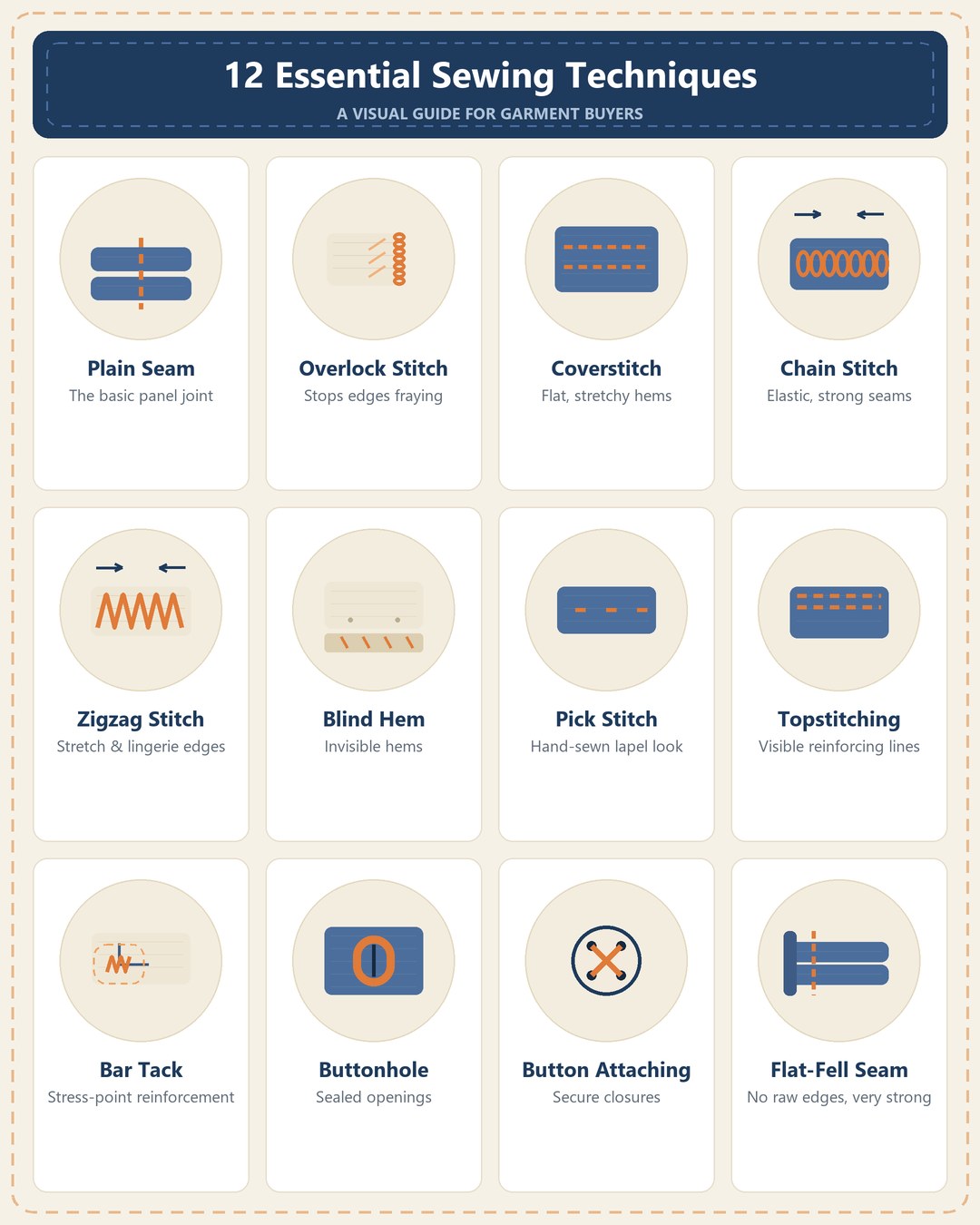
Garment manufacturing relies on 12 core sewing techniques: plain seam, overlock, coverstitch, chain stitch, zigzag, blind hem, pick stitch, topstitching, bar tack, buttonhole, button attaching and the flat-felled seam. Where a factory uses each one reveals most of what determines garment quality.
The 12 Techniques at a Glance
Plain seam - the default joint: two panels sewn face-to-face with one straight lockstitch line (T-shirt side seams, dress panels).
Overlock (serging) - thread wraps the raw edge so knit fabric cannot fray (inside of T-shirts and hoodies).
Coverstitch - parallel face lines with a looper mesh underneath, so knit hems stretch flat (T-shirt hems, activewear necklines).
Chain stitch - a self-locking, highly elastic chain (jeans crotch seams, waistbands).
Zigzag stitch - a Z-shaped line that gives sideways stretch (lingerie edges, elastic).
Blind hem - catches one or two threads for a near-invisible hem (suit trousers, dress hems).
Pick stitch - short spaced stitches that mimic hand sewing (suit lapels, premium jackets).
Topstitching - a visible reinforcing line, usually in thicker thread (denim, pocket outlines).
Bar tack - a dense zigzag block anchoring stress points (pocket corners, zipper ends, belt loops).
Buttonhole and button attaching - precision-cut slits sealed with satin stitching; buttons cross-sewn with a wound thread shank.
Flat-felled seam - raw edges folded inside one flat, strong joint (shirt side seams, jeans inseams).
Buyer Tips: What Good Stitching Looks Like
Plain seams should run straight and even, with no puckering.
Overlocking should be dense and even; loose wrapping signals a rushed line.
Coverstitch lines must stay parallel - uneven lines mean poor machine tension.
Blind hems should show no regular needle dots from the face of the fabric.
Topstitching must keep an even distance from the edge.
Bar tacks must be present at every stress point; missing tacks signal cost-cutting.
Buttons should survive a firm twist - looseness on a sample predicts loose quality control.
How to Check Stitching Quality in 60 Seconds
Turn the garment inside out and check six things:
1. Straight seamlines - no wavering, no skipped stitches.
2. Even density - roughly 8-10 stitches per inch on shirting, 6-8 on denim.
3. Correct stitch for the fabric - coverstitch on knit hems, zigzag on elastic, chain stitch on high-stress seams.
4. Bar tacks present at pocket corners, zipper ends and belt loops.
5. Clean closures - tight buttons, sealed buttonholes with no fraying.
6. Inside as tidy as outside - trimmed threads, no tangled work.
A factory that is disciplined on the inside of the garment is disciplined everywhere. For the full framework, see our factory audit checklist article.
FAQ
What is the strongest stitch in garment manufacturing?
The lockstitch sets the industry standard for strength and consistency; the chain stitch adds stretch. At true stress points, factories rely on bar tacks and flat-felled seams rather than stitch type alone.
Which stitch prevents fabric from fraying?
Overlocking. Three or four threads wrap the raw edge so knit fabric cannot unravel; on wovens it is often paired with a plain seam or flat-felled seam for strength.
How can I tell if a factory's stitching quality is good?
Check inside the garment first: even stitch density, straight seamlines, wrapped raw edges, bar tacks at stress points and trimmed threads all indicate disciplined production. A pre-shipment inspection verifies it at order scale.
Put These Techniques to Work in Your Next Order
XinChengDa Garments is a Shenzhen-based clothing manufacturer with nearly 10 years of OEM and ODM experience. Our sampling team turns tech packs into confirmed samples in 3-7 days, low-MOQ programs help small brands start production, and every order passes a stitching-quality inspection before shipment.
Explore our product collections and fabric sourcing service, learn how low-MOQ manufacturing works, or contact us - email info@xcdgarments.com or WhatsApp +86 187 1945 5226 - to talk through your next style.